
A week before Ganesh , my son Vihang drew various musical instruments ,inspiring me to share my thoughts about instruments in Ganesh Utsav and how peculiar material culture is developed in consonance with cultural practices.
This article explores how a Ganesh Festival is connected to various musical instruments and how this material culture flourishes with cultural practices.
Ganesh Utsav is a big event in Goan society, an event virtually every section of society looks forward to it . A month before in shravan people start preparing for it. The carpenters are called to fix up/ repair traditional wooden devara.The traditional devara is actually frames, multiple ones. They originate from idea of makhar, a divine vehicle for Devata used in Navaratra utsav. The other items which are readied are wooden frame for matoli along with collection of fruits.
There are other items which get readied; primed and tuned… those are musical instruments. In fact so much is demand for this work, craftsmen expert at this migrate to Goa during this pre-Chaturthi period.
‘चवथी’ साठी वाद्ये सज्ज | Musical instruments getting ready for Chovoth | Gomantak Tv
Every cultural practice which is ingrained in society produces material culture, the variety of which gives us idea of its richness. Material culture refers to the physical objects, resources, and spaces that people use to define their culture. From point of sociology these are two interdependent aspects of culture, the cultural practices developed out of ideas and actual physical objects which are used.
From anthropological study of Goan society, it would be interesting to look at musical instruments and their development in society. Musical instruments are reflections of aspirations, celebration, devotion in traditional society.. The musical instruments evolved out of local traditions are key to this understanding.
Musical Instruments & their development
Development of musical instruments in Bharat can be traced to various traditions & regions, however Vedic literature is an important source of archival information on its role in Indian society.

Reference to Karkari string based instrument in Rigveda 2.43.3
If one looks at the early references of matrial culture of music in Rigved, four kinds of musical instruments are being referred
(1) stringed instruments
(2) wind based instruments
(3) Leatherskin instruments
(4) Metallic instruments
All these four typologies have been prevalent in region of Gomantak throughout historical periods.

Dominant South Indian Influence on Goan musical traditions
The development of musical instruments in Goa is related to its geo-political position in Indian history. Goa located in peninsular India is part of South India and it is natural that there is profound south Indian influence on Goan musical instruments. The rule of Bhoja dynasty,Konkan Mauryas, Chalukya Badami, Kadambas as well as Vijayanagara kingdom which was great repository of karnata & Tamil traditions have all but contributed to it.
It was rule of kadamba dynasty that is generally considered as golden or peak period of Goan culture until it was ravaged by series of invasions which were not wars limited between kings but brought havoc & destruction on Goan culture as well as societal structure.
The region of Gomantak was soon divided into two regions, The area under Portuguese and rest of Gomantak under direct or indirect rule of Marathas .The area under Portuguese -the three talukas of Salcette, Tiswadi & Bardez underwent systematic destruction of Goan culture with attempts to supplant it with western faith, western cultural outlook. They succeeded largely but could not wipe out traditional music as well as musical instruments, but rather a blend of musical traditions was created.
The other region under Marathas , prospered as Marathas declared that the state is ‘Hindu’ (vide Adkon stone epigraph) assuring them protection, leading to sustenance of Goan traditions connected to sacred practices.
Development & sustenance of Music
The music of Gomantak region underwent profound development in classical as well as local musical traditions. The rule of Marathas of almost 100 years from 1675 CE to 1763 CE sustained these developments especially in temples which were patronized by them, spreading to rest of Goa. Even today Antruj is considered a great place for musical traditions, so much so most of prestigious Sangeet Sammelan are located in Ponda( Antruj Mahal).
Temples, Utsav & Jatra
The Maratha reign in majority Goan talukas had a sobering effect on Portuguese atrocities and the later period was relatively peacefull.This led to development of music ,art and sustenance of local traditions.
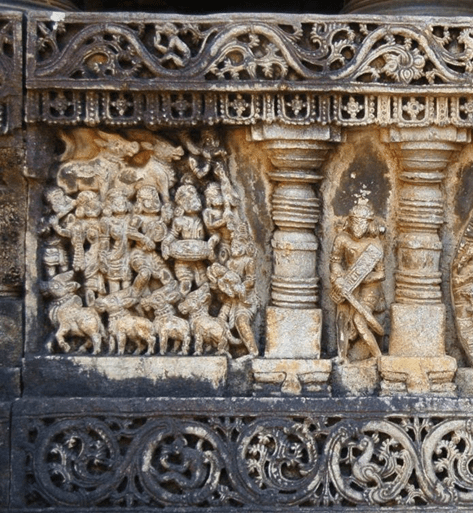
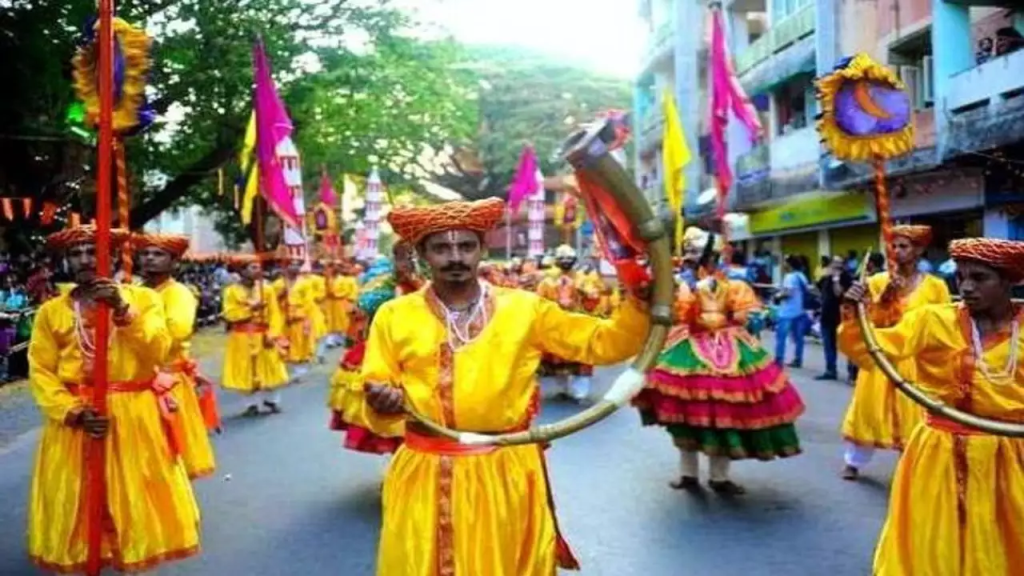
Musical instruments were played in Temple utsav, especially during widespread & well attended temple chariot processions in jatra. The musicians were sustained in temple based Gaokari system( which was modified into communidade system later).
The other festivals are Shigmo, Dhalo, Dhendlo, however it is Ganesh utsav which is when the musical instruments are widely used. In villages Groups of youngsters practice to perform Ghumat Arati in front of Ganesh. Now it is widely established to have such performances in Sarvajanik Ganesh Utsav as it offered many budding artists a wider audience.
Please look at thiese videos to understand this phenomenan
- https://www.dainikgomantak.com/goa/ghumat-aarti-presented-by-youth-in-goa-during-ganesh-chaturthi-avj90
- Ghumat Aarti 2019:Tu Sukhakarta Tu Dukhharta…
- Best ghumat aarti girls group @Ghumat aarti goa
As you can see these musical instruments are not limited to musicians but rather this music culture has pervaded all walks of society and households are taking part enthusiastically.
Goan Musical Instruments
Goan musical instruments in contemporary performancestoday include western instruments as well as modern ones today but hindu sacred practices have largely maintained use of traditional instruments.
Ghumat

This is most sought after instrument in Ganesh festival .It is widely used in Goa, Coastal Karnataka, parts of Shimoga district and South Konkan region. The instrument is quite simple in mechanism but equally difficult for musician to derive rhythm on it.
It is made of earthen vessel which is baked pot with two openings. The leather of monitor lizard is used to cover bigger opening. Generally coir rope is tied to secure the same. In process sap of tree is used in preparation of leather.
Sound is created by striking on leather by right hand while at the same time, left hand is used to cover the smaller opening on opposite side of pot.
Making of Gumot / Goan Tradition / Goan Gumot / Goan Musical Instrument / PART – 3
Kansalem

This is ghanavadya made of copper & copper alloys, consisting of two round flat circular pieces of 15-20 cm diameter. It is a very ancient musical instrument. In smaller version, It is called Zannz .It is also called Tal and most commonly used as it is easy to use. It is commonly used in Puja , arati to create rhythm.
Pakhwaj, & sanai
These are not generally used in household during Ganesh festivals. They are primarily used in temple festivals. But however they are used in sarvajanik Ganesh utsav
Shamel

Shamel is used by Hindus unlike mhadale which is used by Christian gawda community. Shamel is made of local khairi tree and leather of goat is used for the same. It is not as popular as Ghumat but however some groups use it for household celebration also. The other variant of this called jod-Shamel is localized to cancona district only
Nagara, Chaughada
The other instruments used are Nagara, chaughada but they are primarily used in temple or village festival but nowdays they are used for sarvajanic Ganesh festival
There are various other musical instruments such as Dhol ,Jaghant ,Surpavo, kondpavo, naksher, Konno, bankoo and shinga but there use is
Goa’s rural landscape reverberates with ‘Chovoth’ cheer
Read more at: https://www.deccanherald.com/content/95254/goas-rural-landscape-reverberates-chovoth.html
The chovoth or chaturthi is a period of celebration , creativity and expression of ones skills. The musical traditions of Goa survive today due to widespread interest of community in these traditions.
 Bharat Virasat