Shree Ganesh is a popular and most visible deity in Bharatiya culture, his presence is not bounded by geography or Time. Every region or place under Bharatiya civilization or touched by it shows presence of the Ganesh Devata.
The primary role played by Shree Ganesh in Art & architecture is reflective of his primacy in sacred practices, so it is important to understand the same.
Origin Of Shree Ganesh-varied hypothesis

Terracota Ganesh :A Kushan era seal found in Rakhigarhi excavations (https://defence.pk/pdf/threads/we-are-all-harappans.570963/)
While discussing origin of Shree Ganesh ,some scholars like to build hypothesis of Ganesh as Tribal deity or non-Aryan or non-Brahmin deity based on western structured approach of ‘Cultural Conflict’ – Aryan versus Non-Aryan inhabitants or Brahmin versus folk Culture. The approach stems from various assumptions /observations one of which is whether or not he is being referred to in Vedic literature in exact manner we worship today.
This approach is based on structure of Abrahamic religions where a book or group of treatises is a sole source of validation , The approach is not suitable for Sanatan Dharma which is not bound by a book or treatise but more organic civilization evolving out of written-oral-codified- informal-region specific cultural practices which are evolving & transforming with passage of time differently in community specific as well as region specific manner. However without getting stuck with western or counter narrative let us look at footprint of Shree ganesh in our civilization.
Footprint of Shree Ganesh as Adya Devata
Shree Ganesh has footprint of its sacredness as well as worship in all the above-mentioned attributes of cultural practices. It is interesting to note that Shree Ganesh has been considered as Adya-devata or worshipped in beginning in virtually all forms of expression- Art or architecture alike. The expression is not limited to any cultural grouping but spread across from city dwelling to forest dweller community. The aesthetics or fine nuances of these sacred practices have been highly contextual making them diverse & varied. The contextual nature of these practices have resulted into practices which were reflective of natural resources as well as complexity in its form. However the simpler forms need not mean they were the original or early typologies but they are reflective of simpler societal groping or organizations with simpler cultural processes or ideas.
Different texts provide us the important role played by Ganesh in that contemporary period or societal grouping. They also reveal how form of Shree Ganesha was conceived and how it underwent transformation & development across the period to fully evolve into the form we conceive of presently,
Presiding deity in Vedic literature
Rigved one of the earliest Hindu Treatise in its reveals the concept of Ganapati associated with various divinities as well as Brahmanaspati.

Among the celestial attendants (Ganas), you are the Lord (Ganapathi), We offer sacrificial oblations to you.You are the wisest among the scholars. Your wisdom is known to be highest quality and uncomparable for its glory.
You are the eldest or foremost of the kings (referring to devas), the Lord of the sacred prayers, rituals and its performers (Brahmanaspati)O Lord, come to us by hearing our hymns and be seated in this sacred sacrificial altar.
While Atharva Veda builds association of Elephantine form with it , it is vedic literature such as Maitrayani samhita (2.9.1) and Taittiriya Aranyaka (10.1.5) that contain references to hastimukha i.e elephant face deity with single tusk with curved trunk who holds corn, sugarcane & club –clearly defining Ganesh as we worship today.

The purpose of these references is not to build chronology in these references as many of compilations dated to particular period may contain repository of earlier wisdom so the purpose is to understand Ganesh being worshipped as presiding deity in Vedic compilations.
Primacy of Shree Ganesh in Tantra worship: Ganesh presiding on first Chakra

Shree Ganesh plays equally important role In tantra & Yogic practices . In Yogic practices the concept of seven chakras & transition of seekers consciousness through various chakra is very important. The chakras beginning at Muladhar chakra followed by Swadhisthan Chakra-Manipura Chakra-Anahat Chakra-Visshuddha Chakra-Ajna Cahkra-Sahasrar chakra denote the process of ascension of consciousness through various stages . The process begins at Muladhar chakra , which is the place of shri Ganesh along with preiding deities-Shree Brahma ,Airvat ( seven headed elephant of Indra) and Dakini devi.
त्वं मूलाधारस्थितो॑सि नित्यम्
You continually dwell ( unavoidable/need to pay obeisance )in the mūlādhāra chakra
Shree Ganesh also officiates opening of first chakra, the Muladhara Chakra, denoting preservation, survival and well being of the sadhak or practioner.
Invoking Ganesh as beginning of all performances
We all know that Ganesh vandana is a common across India prior to beginning of performances. Different rituals performed to different Devata have Ganesh Pujan as indispensable part of the ritual
Ganesh is considered removal of obstacles so he is prayed to generally as follows
अभिप्रेतार्थसिद्ध्यर्थं पूजितो यः सुरासुरैः ।सर्वविघ्नच्छिदे तस्मै गणाधिपतये नमः ॥
For desired success of Gods & Asur worship him, for he is one who destroys all obstacles
Salutations to the chief of all Ganas.
Ganesh Vandana or stuti is performed in all performances be it singing or dance performances; the mode of presentation however varies.
Ganesh Vandana by
Ganesh Puja in Goan Theatre
Dashavatar kalo was most preferred in Goan theatre prior to popularity of commercial theatre. As per government records, in the past, around 350 temples performed Kalo on the occasion of the annual fair in Goa.
Today this art is greatly retained & sustained in Konkan region especially Devgad District .It was performed in many villages where the artist were sourced from the local community. They were not professional actors rather people from all walks of life prepared and harnessed their love for art. They practiced before village fair or Gramdevata Utsav as these were occasion for village to get together. It is said that this theatre performance is almost 800 years old.
These performances were executed without any technical setup. The play consisted of two sessions –Poorva Rang ( Prior performance) and Uttara Rang (Latter Performance). Ganesh was invoked and Person wearing costume and mask used to appear on stage. This was foremost to Dashavatara kalo performance. The performance was enhanced by traditional music instruments such as Harmonium, Tabla and Zanz.

Ganesh mukhavata( mask) was important part of this theatre performance and was revered along with the instruments used to depict Gods. While other Gods used to be depicted by facial painting & adornment, Ganesh part was performed always with mask. The same was retained as important and due sanctity was given to the same

Art synergy at Savoi Verem’s traditional Kalo
http://timesofindia.indiatimes.com/articleshow/88287043.cms?utm_source=contentofinterest&utm_medium=text&utm_campaign=cppst
GANESH VANDANA | KONKANI | FOLK MAHOTSAV | ANTRUZ YUVA KALAKAR | GOA
Ganesh in Architectural Iconography
Mandir sthapatya is a resultant of cultural practices, beliefs and philosophy of the civilization. It is also an art, where physical body of Ishwar tatva is created with great harmony. That is why there are so many codified rules, proportion system so that creation is in sync with chanda..the rhythm of creation. In Mandir Sthapatya ( Temple architecture), iconography is an important constituent and albeit inseparable one. Here we are not speaking of vigrahas in worship but pratima which adorns the architectural assembly or composition and makes it complete.
In Temple architecture, the entrance gateway is considered very important and auspicious. Even during consecration there are separate rituals for sanctifying gateways including Savatsa Dhenu– cow with her calf.
The doorway is designed to have dual function; first it is to condition devotee by giving him sense of crossing into sacred space by crossing threshold, orienting his mind to sacred. The second function is to ward off evil from entering sacred space.
Doorway consists of frame, threshold as structural members; the sides are associated with attendants or guardians, while top center is called lalat which is officiated by devata or motif.


Sthapatya shastras decree that the idol shall be of the main Devata or close associate one being worshipped in the garbha griha, however Shree Ganesh is an exception.
Prasadmandanam Devavastushasta recommends the following
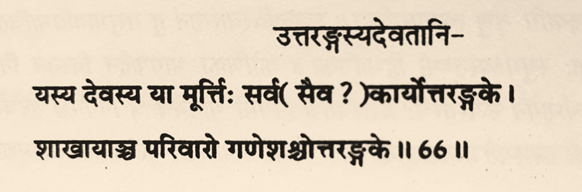
On forefront make idol of God being worshipped, on sides the associated pantheon may be carved. Ganesh may also be carved on the top panel.
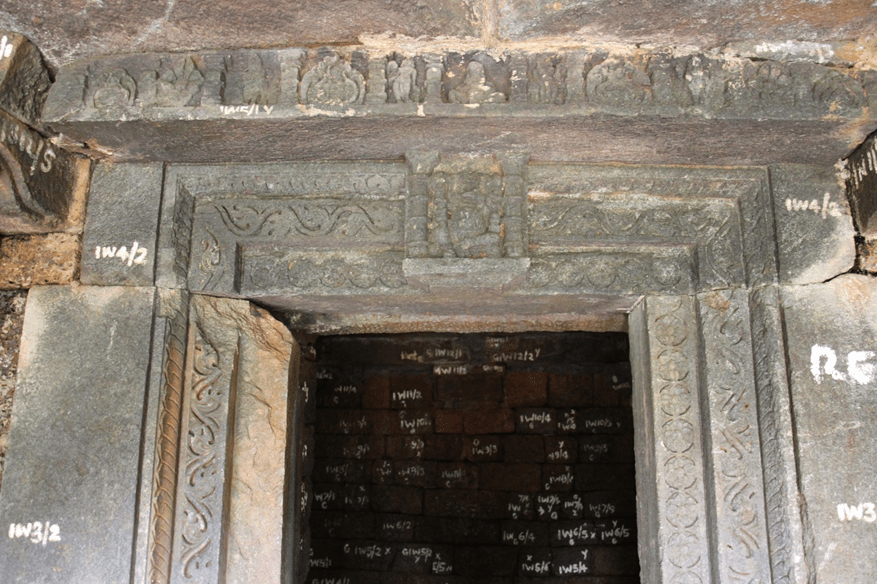
This is a common norm adopted across Bharat and one can find Ganesh pratima on doorway in almost all temples .The usual distinction of shaiva-vaishnav or shakt does not limit use of Ganesh pratima.
Lalat Ganesh Pratima in Goan Temples
The pan-Bharat norms are adopted for Goan temples also. Most temples in Goa irrespective of whether they belong to shaiva or vaishnav traditions adorn Ganesh on the door lintel. The Shiva Temple at Kurdi is one of the oldest stone temples in Goa dated to 9th/11th/13th century, almost 800 -1000 years old. The temple was transplanted in as the site was submerged in Salaulim dam.
The Shree Keshav temple in Priol belongs to post-Vijayanagara period possibly in It contains stone door assembly which is stylized in wooden decoration forms. It also adorns Ganesh carved on lalat in schist stone below chatra stone.
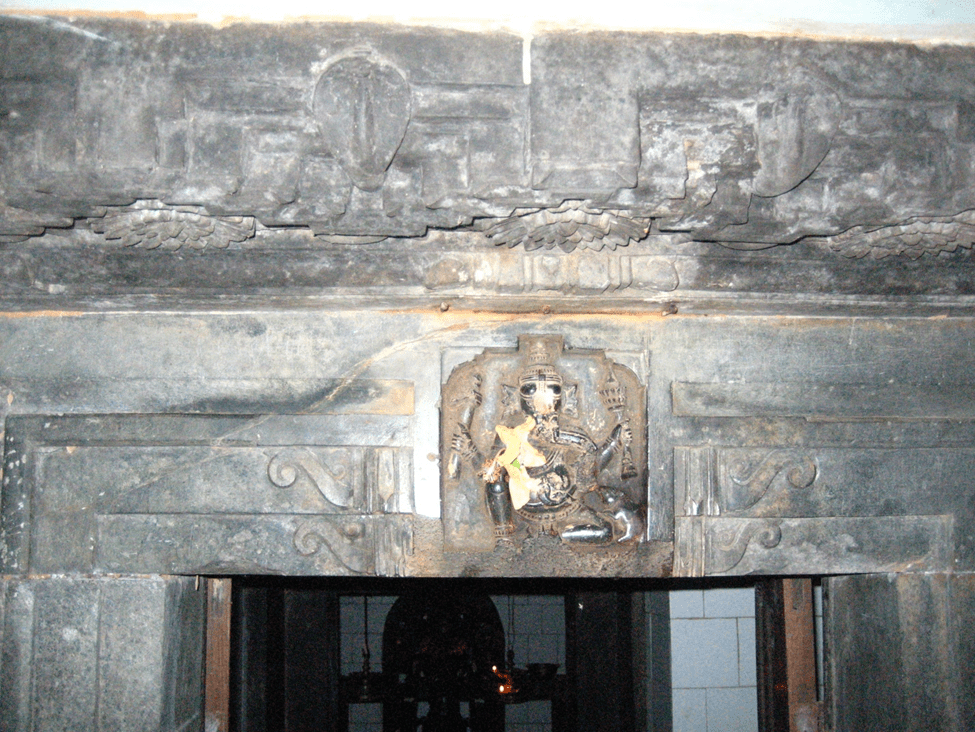
It must be noted that Ganesh in lalat is not for decoration but is considered active and part of Puja-archana of temple
The wooden temple typology also uses Ganesh as Lalat devata.

Ganesh as Beginning…
As we can see the role of Shree Ganesh in all art forms, rituals is very important. In a civilization such as ours, diversity is the key word; Ganesh retains his primary position across the length & breadth of civilization. The various periods in history from ancient period, upheavals do not change this fact. Variety of worship systems, various sects all accept the primary officiating position of Ganesh. The same is reflected in Goan Theatre as well as architectural iconography. Ganesh is undoubtedly primary-Pradhan devata and there is no beginning without him…
[1] Maitrayani samhita is an ancient Sanskrit compilation which is part of Krishna Yajurveda.Also called as Maitri Upanishad,it is rfered to in various schools of thought – Buddhism, Samkhya , Yoga & Sanatan Dharma.
 Bharat Virasat